Preparation & Guide
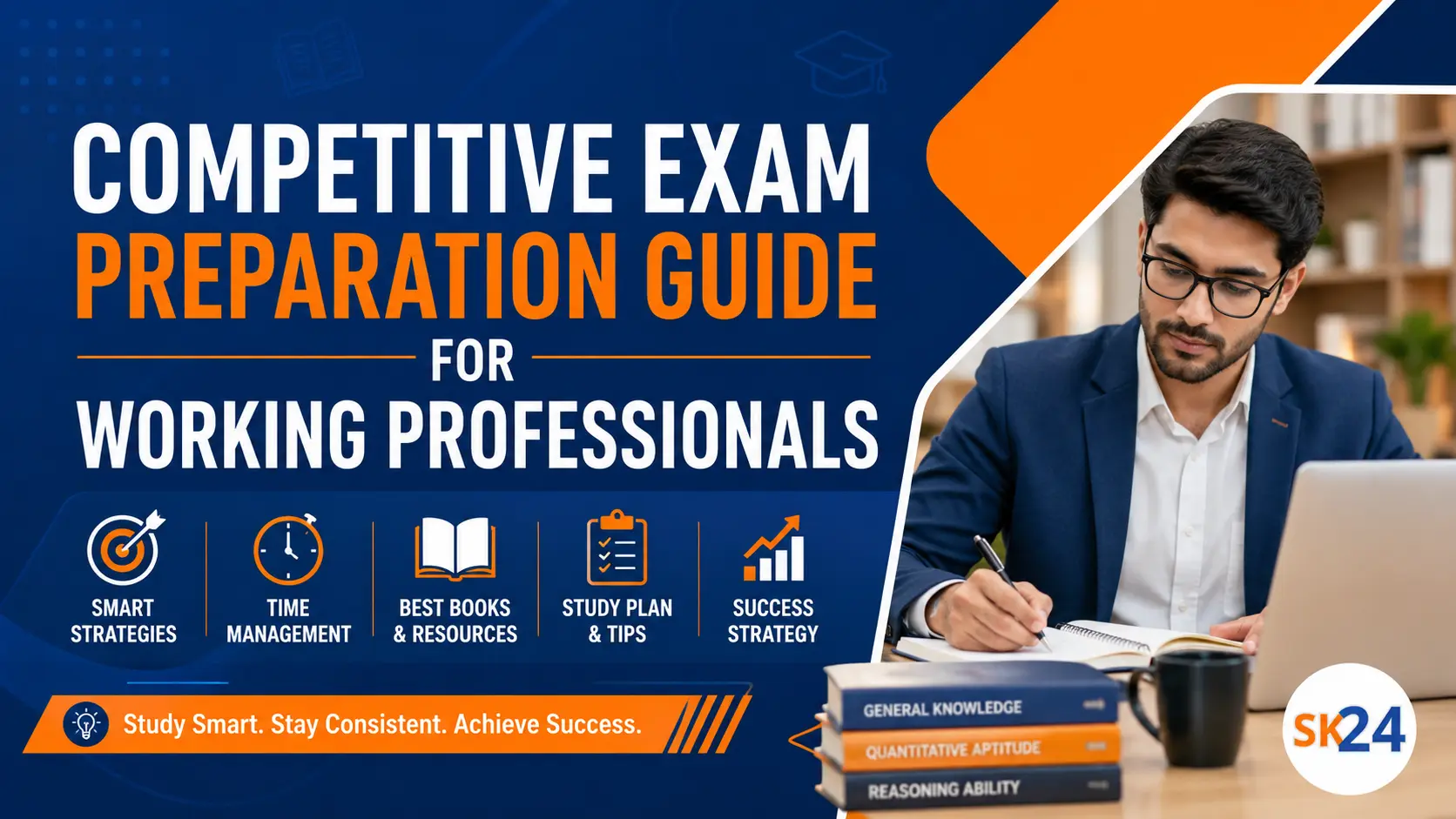
Competitive Exam Preparation Guide for Working Professionals
May 29, 2026361 views0 commentsSarkarikhabar24
Preparation & Guide
Competitive Exam Preparation Guide for Working Professionals is designed for employees, private-sector professionals, government workers, and anyone balancing a full-time job with exam preparation. If you want to prepare for UPSC, SSC, Banking, Railways, State PSC, Insurance, or other competitive exams without leaving your job, this guide will help you build an effective study plan, manage time efficiently, choose the right resources, and improve your chances of success. With the right preparation strategy, even a busy professional can compete successfully while maintaining work-life balance.
| Details | Information |
|---|---|
| Exam Name | Competitive Government & Professional Exams |
| Category | Preparation & Guide |
| Difficulty Level | Moderate to High |
| Mode | Online / Offline |
| Best For | Working Professionals & Job Holders |
| Official Website | Check the respective exam authority website |
Competitive exams continue to be one of the most reliable ways to secure stable and rewarding career opportunities.
Successful candidates can enter:
Benefits often include:
Government and public-sector recruitment continues every year, creating opportunities for aspirants from various educational backgrounds.
Working professionals have limited study hours, so efficiency matters more than total study time.
If you are starting from scratch:
| Time | Activity |
|---|---|
| Morning (1 Hour) | Current Affairs |
| Evening (2 Hours) | Core Subjects |
| Night (30 Minutes) | Revision |
After 1–2 months:
For candidates nearing the exam:
Mock tests help:
Aim for:
Even 3 focused hours daily can produce excellent results.
Study during:
Dedicated study sessions are more effective than long distracted sessions.
| Subject | Best Book | Author | Recommended For |
|---|---|---|---|
| Quantitative Aptitude | Quantitative Aptitude | R.S. Aggarwal | Beginners |
| Reasoning | Modern Approach to Verbal & Non-Verbal Reasoning | R.S. Aggarwal | All Levels |
| English | Objective General English | S.P. Bakshi | SSC & Banking |
| General Knowledge | Lucent General Knowledge | Lucent Publication | All Exams |
| Current Affairs | Monthly Current Affairs Magazine | Various | Government Exams |
| Mathematics | Fast Track Arithmetic | Rajesh Verma | Intermediate |
Always use:
Useful resources include:
Look for channels that focus on:
Choose one trusted educator per subject instead of following too many sources.
Always verify the latest syllabus from the official website.
| Section | Marks | Duration |
|---|---|---|
| Quantitative Aptitude | 25 | Varies |
| Reasoning | 25 | Varies |
| General Awareness | 25 | Varies |
| English Language | 25 | Varies |
| Exam Type | Negative Marking |
|---|---|
| SSC Exams | Usually Yes |
| Banking Exams | Usually Yes |
| Railways | Depends on Notification |
| State Exams | Varies |
Target:
| Activity | Time |
|---|---|
| Current Affairs | 30 Minutes |
| Core Subject 1 | 60 Minutes |
| Core Subject 2 | 60 Minutes |
| Revision | 30 Minutes |
Total: 3 Hours Daily
Many working professionals lose valuable preparation time due to avoidable mistakes.
❌ Following too many books
❌ Ignoring revision
❌ Skipping mock tests
❌ Studying without a plan
❌ Watching excessive strategy videos
❌ Comparing yourself with full-time aspirants
❌ Neglecting sleep and health
✔ One book per subject
✔ Weekly revision
✔ Regular mock tests
✔ Consistent routine
Previous Year Questions reveal actual exam trends.
Quick revision becomes easier before exams.
Studying 3 hours daily for months is better than studying 12 hours occasionally.
Most aspirants forget because they do not revise enough.
Take breaks and maintain a healthy routine.
Use platforms as supplements, not replacements for self-study.
Start by understanding the syllabus, exam pattern, and previous year papers before choosing study materials.
A focused 2–4 hours daily is generally sufficient when combined with consistent revision.
R.S. Aggarwal, Lucent GK, S.P. Bakshi, and Rajesh Verma books are commonly recommended.
Yes. Many candidates clear competitive exams through disciplined self-study and regular mock practice.
No. Coaching can help, but self-study with quality resources can also lead to success.
Begin mock tests after understanding the basics, ideally within the first month.
Focus on fundamentals, syllabus coverage, and daily consistency before attempting advanced practice.
Weekly revision and monthly full-syllabus revision are highly recommended.
This Competitive Exam Preparation Guide for Working Professionals shows that clearing competitive exams is possible even with a full-time job. Success depends on smart planning, consistent study habits, regular revision, mock test practice, and disciplined time management. Focus on completing the syllabus systematically, follow a practical study plan, use the best books, and stay updated with official notifications. Most importantly, remain consistent and track your progress every week.
Author
Our editorial team tracks official notifications, exam updates, recruitment announcements, and public-interest explainers with a focus on clarity, source verification, and practical guidance for readers.
Learn how to access the official PAN card form 49A download PDF. Discover step-by-step instructions to flawlessly apply for a new PAN or request card corrections.
Download the official Aadhaar card correction form PDF download 2026. Discover step-by-step instructions to flawlessly update your demographic and biometric records via UIDAI.
Access the latest official IRS Form W-4 download PDF. Learn step-by-step instructions to fill out your withholding certificate accurately and keep your paycheck protected.
Reader Notes
No comments yet. Start the conversation.
Copyright (c) 2026 Sarkari Khabar 24. All rights reserved.